
GLP-1 Dose Calculator
Compounded GLP-1 medications require you to calculate syringe units from your prescribed milligram dose and vial concentration. Dosy's built-in calculator does this conversion instantly — but always verify with your provider.
Why GLP-1 Dosing Math Matters
With pre-filled pens (Ozempic®, Mounjaro®), you dial or click to your dose — the pen handles the math. With compounded GLP-1 vials, you must calculate how many syringe units to draw based on three variables:
How the Conversion Works
The fundamental relationship between dose, concentration, and volume:
Syringe units = Volume (mL) × 100
| Dose | Concentration | Volume | Units |
|---|---|---|---|
| 0.5 mg | 5 mg/mL | 0.1 mL | 10 units |
| 1.0 mg | 5 mg/mL | 0.2 mL | 20 units |
| 2.5 mg | 5 mg/mL | 0.5 mL | 50 units |
| 0.5 mg | 2.5 mg/mL | 0.2 mL | 20 units |
| 1.25 mg | 2.5 mg/mL | 0.5 mL | 50 units |
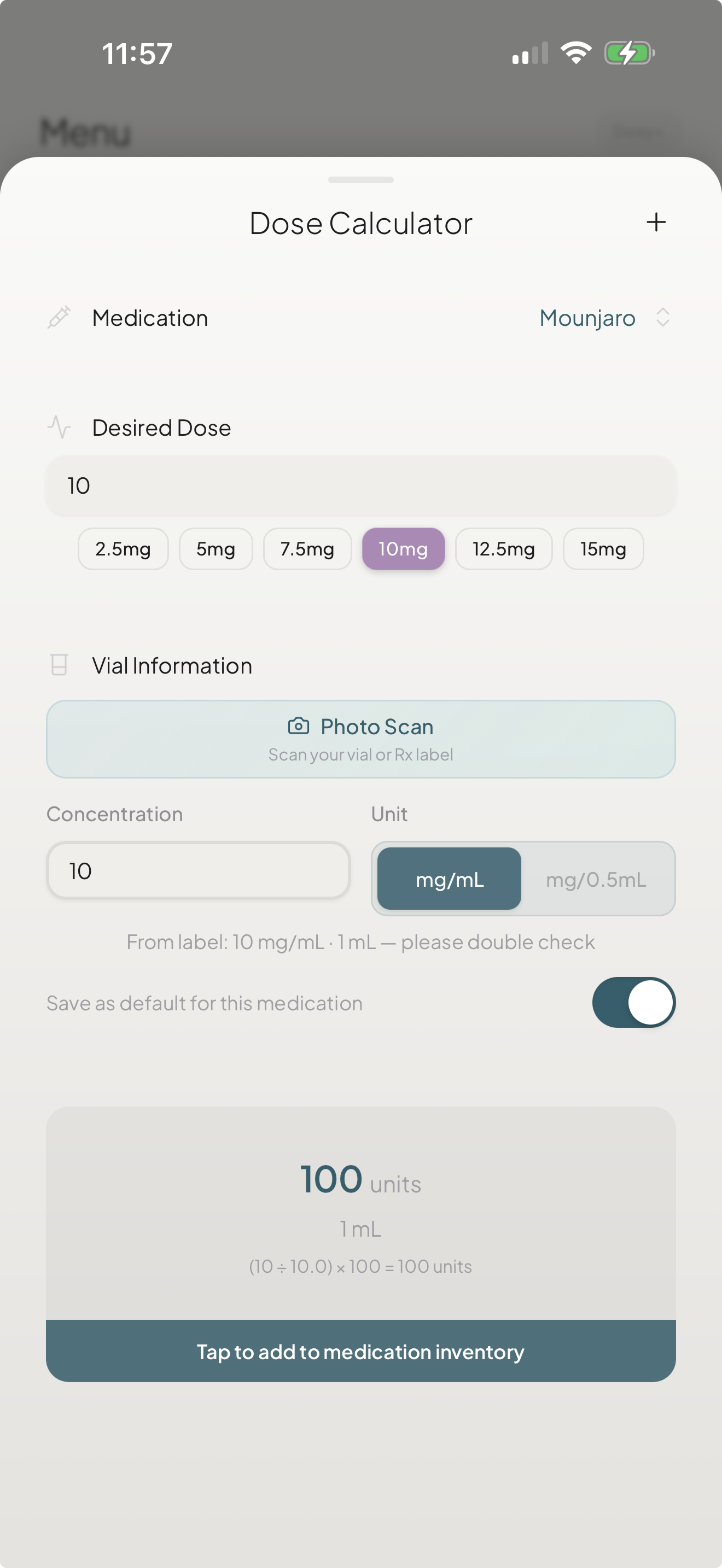
Dosy's Built-In Dose Calculator
Medical Disclaimer
Dosy Health is an educational and tracking tool only. It does not provide medical advice, diagnosis, or treatment recommendations. All dosing decisions must be made by your healthcare provider.
Do not rely on any app, including Dosy, as a substitute for professional medical guidance. Always confirm your dose and injection instructions with your prescribing provider and pharmacist.
Dosy Health is not affiliated with, endorsed by, or associated with Novo Nordisk (manufacturer of Ozempic®, Wegovy®, Saxenda®, and Victoza®), Eli Lilly (manufacturer of Mounjaro®, Zepbound®, Trulicity®, and Foundayo®), or any compounding pharmacy.
Calculate Your Dose Instantly
Free dose calculator built into Dosy. Works with any compounding pharmacy concentration.


Sources
- U.S. Food & Drug Administration. "Compounding and the FDA: Questions and Answers." FDA.gov
- BD (Becton, Dickinson and Company). "Understanding Insulin Syringes." BD.com — Reference for standard syringe calibrations (100 units/mL).
- 21 U.S.C. § 353a (Section 503A) and § 353b (Section 503B) — Federal Food, Drug, and Cosmetic Act provisions governing pharmacy compounding.
- Institute for Safe Medication Practices (ISMP). "Syringe Dose Calculation Errors." ISMP Medication Safety Alert, 2022.